

Architecture at a Glance
Everstrike has three tightly connected components that work together on every trade. On-chain custody and settlement holds your funds in Everstrike smart contracts deployed on supported networks (Arbitrum One, Base, Ethereum, and Binance Smart Chain). Funds are categorized by their available use (free, locked, staked, or deposited) and only move on-chain when you deposit, stake, or withdraw. Off-chain matching and risk is where orders live. When you submit an order, the risk engine validates it and checks your margin, then the matching engine applies price-time priority to find a counterparty. Because this all happens off-chain, order processing is fast and responsive without paying gas on every trade. Off-chain state channels maintain a rolling, mutually signed record of your balances and positions between you and the operator. The state channel can be revoked by either party at any time. Your latest signed state receipt is the foundation of Trustless Withdrawal, an emergency path you can use without operator cooperation.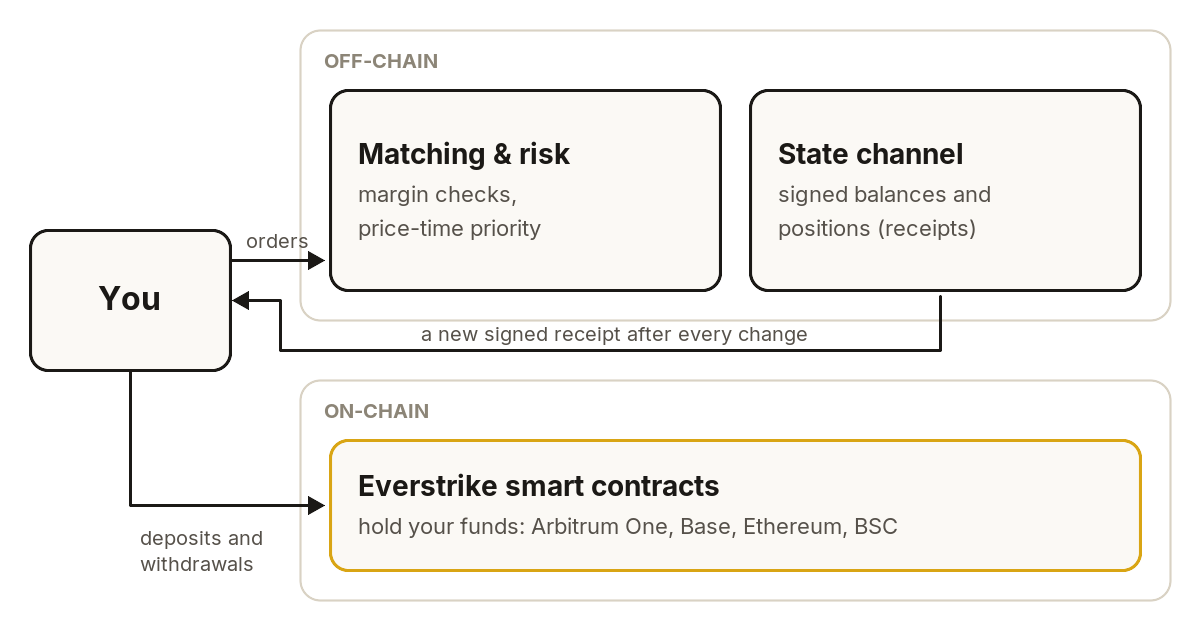
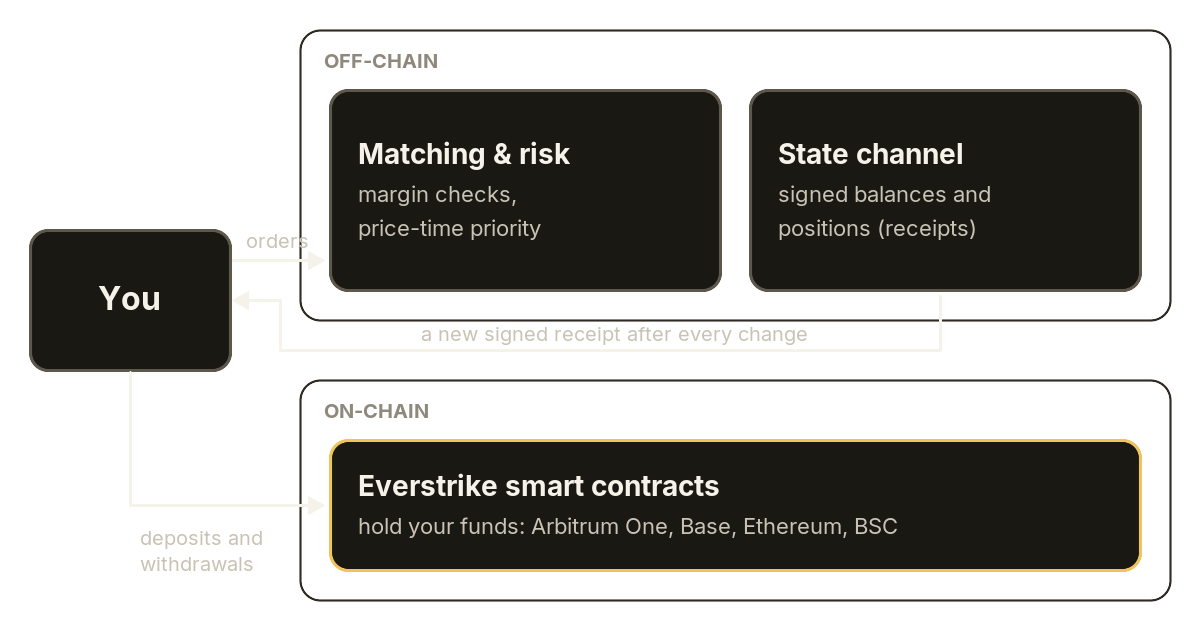
What runs off-chain and what stays on-chain.
Order Flow
Every trade on Everstrike follows the same five-step path from submission to settlement.1
Submit an order
Send your order to Everstrike through the REST or WebSocket API. The order specifies the instrument, side, size, and price.
2
Risk engine validates
The risk engine checks that your order is well-formed and that your account meets the required margin. Invalid or under-margined orders are rejected here.
3
Price-time priority applied
Valid orders enter the internal order book. The matching engine applies FIFO price-time priority: best price first, and within the same price level, earliest order first.
4
Match updates balances and positions
When a match occurs, the relevant balances and positions update in the state channel. Unmatched orders remain in the order book until they match or are cancelled.
5
You receive an updated state receipt
After any change to your balances or positions, you receive a new signed state receipt. This receipt is your proof of the agreed state of your account.
Custody and Recovery
Your funds remain on-chain throughout your trading session. Open orders and positions use locked funds as margin: they cannot be withdrawn until the position is closed or the order is cancelled. The state channel maintains a rolling record of your balances and positions. Your latest signed state receipt always reflects the current agreed state. If the operator refuses to process a normal withdrawal, you can submit that receipt directly toEverstrike.sol to initiate a Trustless Withdrawal. This process is permissionless and censorship-resistant.
Trustless Withdrawal is an emergency mechanism, not a routine path. It requires a 24-hour challenge period during which you must stop trading, and it carries significant fees. Use a standard withdrawal for everyday fund movements.
Explore the Components
On-Chain Settlement & Custody
Understand fund categories (free, locked, staked, deposited), the fund lifecycle, and which operations you pay gas for.
Off-Chain Matching
Explore how the risk engine validates orders, how FIFO price-time priority works, and where the matching infrastructure is deployed.
Off-Chain State Channel
Learn how state receipts track your balances and positions, what triggers a new receipt, and how to recover one if it is lost.
Trustless Withdrawal
Walk through the emergency withdrawal process, the 24-hour challenge window, the fee structure, and pre-submission safety checks.